Pick up an apple at your local fruit stall this June. It’s crisp, shiny, and crunches the way an apple should. It was most likely picked last October.
That isn’t a trick, and it isn’t bad fruit. It’s the quiet work of the cold chain, the network of cold rooms, refrigerated containers and cold warehouses that keeps food fresh from farm to fork. When it works, you never notice it. When it breaks, fruit rots on a highway and farmers lose a season’s income.
A short harvest, a year-round shelf
Kashmir grows about 75–80% of India’s apples, roughly 20–25 lakh tonnes a year, and most of it is picked between late August and November. Yet we buy apples in every month of the year.
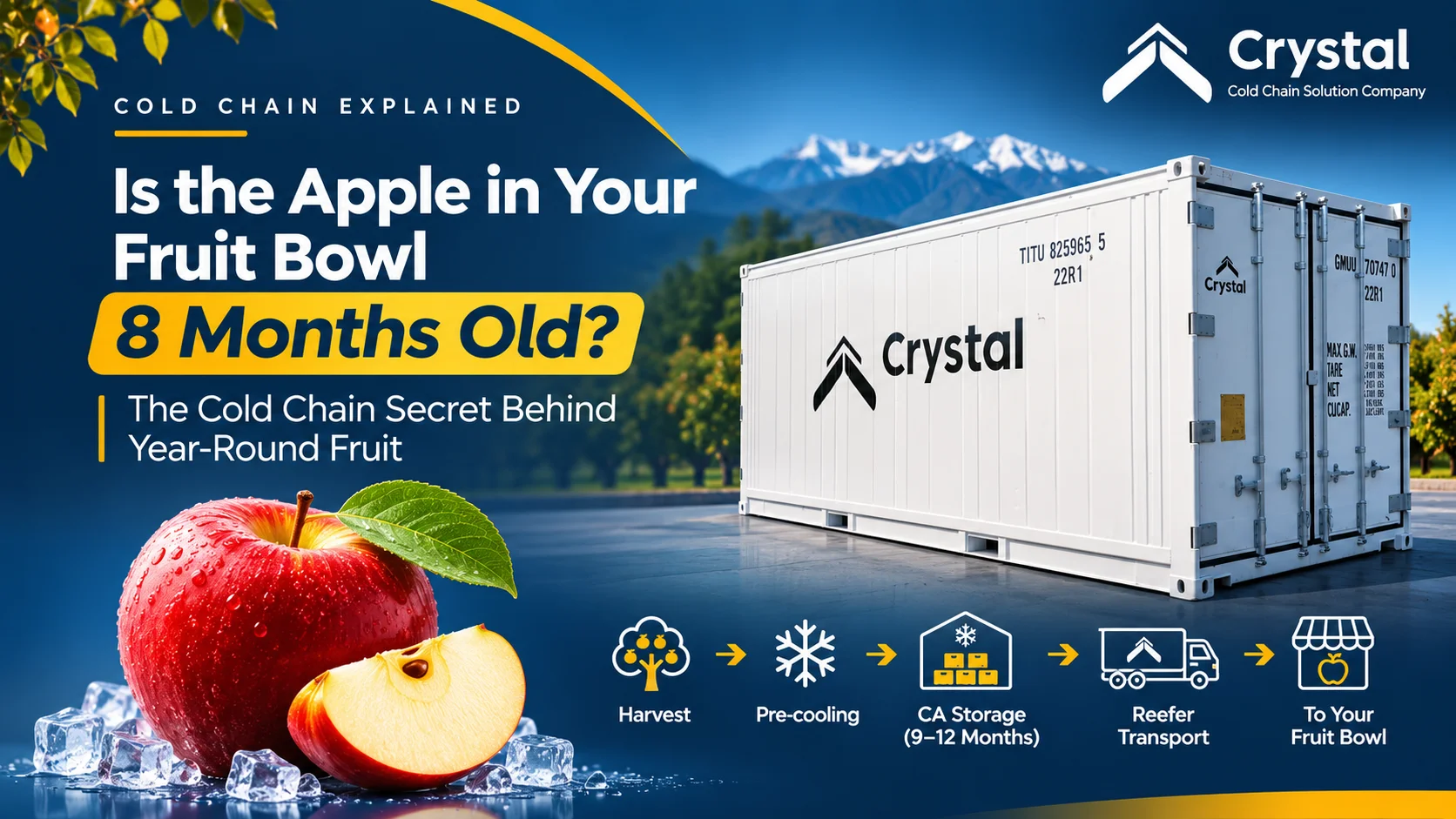
Cold storage fills that gap. In a regular cold store, apples stay fresh for about two to three months. In a controlled atmosphere (CA) store, they can last nine to twelve months. So that crisp apple in May has probably spent most of the year quietly “sleeping” in a cold chamber.
Your fruit is still alive
Here’s the part most people don’t know: a picked apple hasn’t stopped living. It keeps breathing, taking in oxygen and giving off carbon dioxide, water and heat. It also releases ethylene, a natural gas that tells fruit to ripen. That’s why one ripe banana makes the whole bunch ripen faster.
Every hour of breathing uses up the fruit’s sugar, firmness and juice, and heat speeds it all up. So the first enemy isn’t the long trip to market. It’s field heat, the warmth fruit carries from a sunny orchard. Removing it quickly, a step called pre-cooling, decides how long the fruit will last. Put simply, cold chain is the art of slowing a fruit’s breathing down and keeping it slow, without a single break, all the way to your kitchen.
How a CA store keeps apples fresh for a year
A controlled atmosphere store is a sealed cold room that changes the air itself. It keeps apples just above freezing and very humid, then lowers the oxygen from the normal 21% in air to just 2–3%, with a little extra carbon dioxide. The fruit can barely breathe, so it ages very slowly. There are no chemicals involved, only cold, moisture and the natural gases found in air.
There’s one catch. A CA store can only keep quality; it can’t bring it back. Fruit has to go in at the right ripeness and already cooled, which is why the first few hours after harvest matter so much.
What happens when the chain breaks
Kashmir found out last September. Landslides closed the Srinagar–Jammu highway right at peak harvest, and about 22,000 tonnes of apples, roughly 2,200 truckloads, were stuck for almost two weeks. Most of those trucks weren’t refrigerated. Fruit that could have lasted months in cold storage began to spoil within days, and losses were estimated at over ₹1,000 crore.
The road was the trigger, but the real problem was that most of the harvest had nowhere cold to wait. A cold buffer close to the farm, even a temporary one, turns a disaster like this into a simple delay.
India’s weak link is the first mile
India loses about ₹1,52,790 crore of farm produce every year after harvest, and fruits and vegetables are hit hardest. Surprisingly, the main problem isn’t a shortage of big cold warehouses. The National Centre for Cold-chain Development found cold storage capacity was only about 8% short of need. The gaps closest to the farm were far bigger:
- Refrigerated transport was about 85% short
- Ripening chambers were about 91% short
- Pack houses, where produce is pre-cooled and packed, were about 99% short
Add the fact that about 97% of fruits and vegetables travel by road, often in open trucks, and the picture is clear. Produce warms up in its first few hours, and that’s where much of its shelf life is lost.
Reefer containers and cold warehouses: working together
A strong cold chain uses both. Cold warehouses hold large volumes for weeks or months near big markets. Reefer containers are refrigerated shipping containers with their own cooling unit. They move produce by road, rail or sea, and they can also be parked at an orchard, farmer group or mandi as a plug-in cold room. Set up in days instead of years, a reefer can be leased for one harvest and moved to the next. That makes it one of the fastest ways to close the first-mile gap.
How Crystal helps
Crystal covers the whole chain: pre-cooling, sorting and packing right after harvest; reefer containers for farm-gate storage and transport; temperature-controlled cold warehouses and 3PL; modular cold rooms near markets; and refrigerated transport across India. We have been in cold chain since 2000 and hold FSSC 22000, ISO 22000 and FSSAI certifications.
If you grow, trade, process or sell fresh produce, write to us at marketing@crystalgroup.in. After all, the apple you sell in June is only as good as its first hour in October.